


Anxiety and panic
When your mind knows you're safe, but your body hasn't received the message.
For adults across Ontario living with trauma, anxiety or burnout that talking alone hasn't shifted. Online therapy with Anjana Iyer, Registered Psychotherapist.


Featured on
 Verified profile
 CRPO #17275Registered
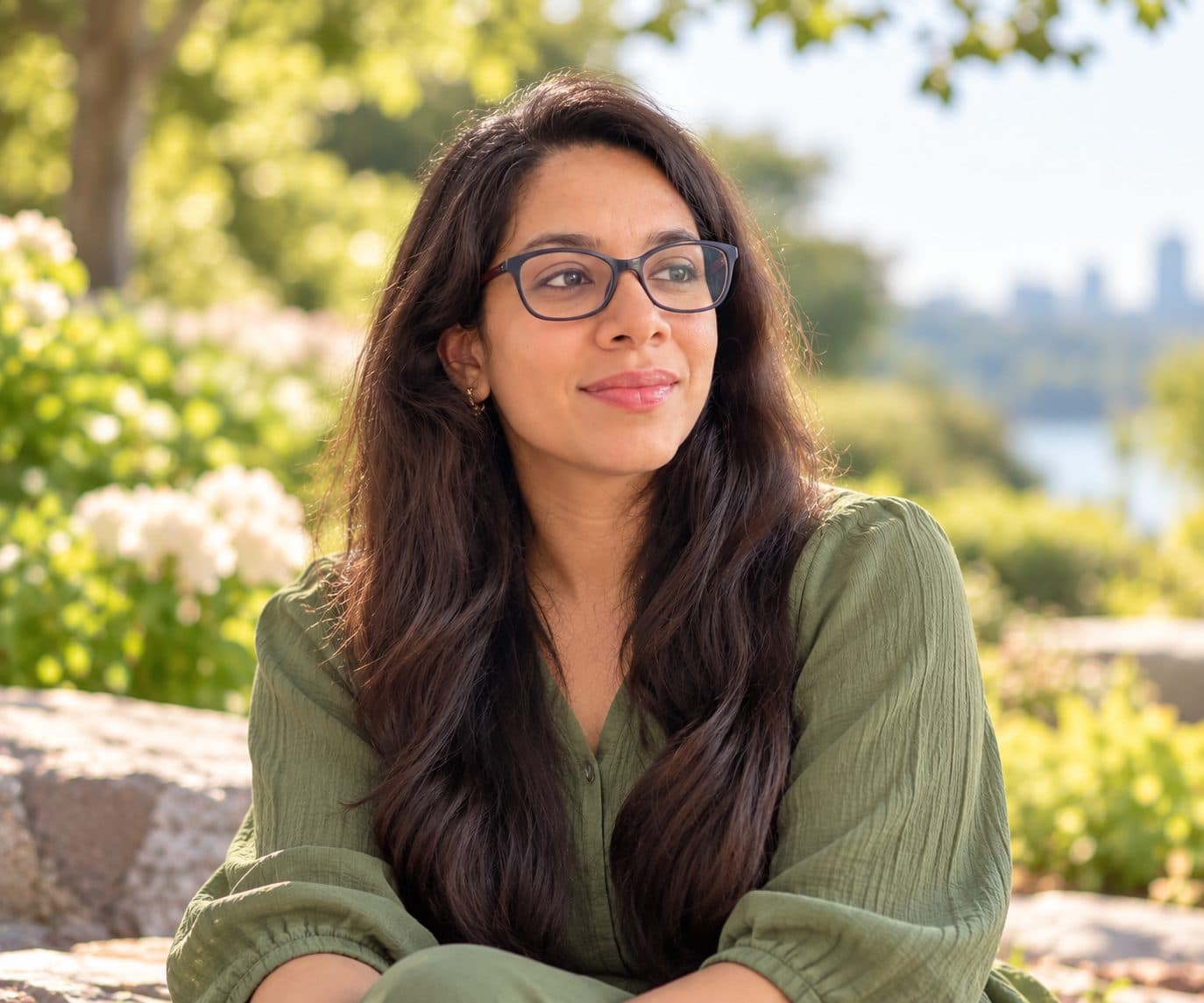
Hi, I’m Anjana. I work online with adults across Ontario who are living with trauma, anxiety and stress.
Fifteen minutes tells you more about whether someone is right for you than another evening of comparing profiles.
Fifteen minutes, free, with nothing to prepare and no obligation to book sessions.
I’m a Registered Psychotherapist (CRPO #17275) with an M.A. in Counselling Psychology, and I see adults online from anywhere in Ontario.
I’m more interested in you as a person than in any label. My training is grounded in trauma-informed care, with additional training in EMDR and Integral Somatic Psychology. That lets us work with the experiences you remember and with the ways they still show up in your body, your emotions and your relationships.
Healing doesn’t mean becoming a different person. It means finding your way back to yourself, with more compassion, more choice, and a greater sense of safety.
Whether this is your first time in therapy or you’ve already tried a few therapists, you’re welcome here. You don’t have to know what you need before we start.

You don’t need the right words, and you don’t need to have it figured out before you begin. You’re welcome exactly as you are.
You shouldn’t have to take a therapist’s word for it. In Ontario, the College of Registered Psychotherapists of Ontario (CRPO) maintains a public register where you can verify a Registered Psychotherapist’s registration and status.
My registration is CRPO #17275, and I am authorized for independent practice. I work in English, and sessions are held online across Ontario.
You’re welcome to verify my registration yourself.
CRPO
Registered Psychotherapist
Authorized for independent practice
Verified on
Licence and credentials confirmed
Verified by their team, not self-declared
My registration tells you I’m qualified to do this work. It can’t tell you whether I’m someone you’d feel at ease talking to. Fifteen minutes on a free call, by video or phone, can.
Talk with Anjana, freeTalk with AnjanaFifteen minutes, free, with nothing to prepare and no obligation to book sessions.
You set the pace. EMDR may involve bringing a difficult memory to mind, but you do not have to recount every detail or describe the experience in full. We begin by developing enough stability and grounding to approach difficult material safely.
The goal isn’t to make you relive what happened. We work with the memory as it exists now, including the thoughts, emotions, and body sensations connected to it. If something becomes too much, we slow down, pause, or stop. That is part of the work, not a failure of it.

When your mind knows you're safe, but your body hasn't received the message.
Including experiences that began in childhood and continue to shape how you feel, relate, and respond today.
When it wasn't one event, but a long stretch of experiences that left your body and nervous system constantly adapting.
The kind of exhaustion that sleep, time off, or a holiday doesn't seem to fix.
Anxious pursuit, avoidance, disconnection, or the shutdown that can follow when closeness feels overwhelming.
When something has changed, been lost, or simply become too much to carry while continuing to keep it together.
M.A. Counselling Psychology
The foundation for how I understand people, emotional patterns, and the therapeutic relationship.
EMDR
A structured, trauma-focused approach for working with distressing memories and the ways they continue to affect you in the present.
Integral Somatic Psychology
Working with emotions as they are experienced in the body, so they can be noticed, understood, and processed, not only talked about.
Cognitive Behavioural Therapy
For patterns that can shift when we change how you respond, what you do, and how you understand what is happening.
Mindfulness-based approaches
Developing awareness and attention that can support regulation and give you practical skills to use between sessions.
Expressive modalities
Art, movement, and body-based practices for experiences that may be difficult to put into words.
Registered psychotherapists are not permitted to publish client testimonials in Ontario, and I would not want to. These are endorsements from other registered therapists, left publicly on my Psychology Today profile.
Anjana brings something rare to her work: a trauma-informed, somatic approach grounded in EMDR and genuine attunement. She holds clients through the kind of healing that goes beyond the surface. A colleague I refer to with confidence.
Blanca Alagon
Registered Psychotherapist
Anjana is a thoughtful, compassionate, and highly skilled psychotherapist. She brings warmth, professionalism, and genuine care to her work, creating a supportive space where clients can feel understood and empowered to make meaningful change.
Max Tkachenko
Registered Psychotherapist, MEd, C-EFIT
Anjana is a compassionate therapist who supports adults with anxiety, trauma, relationship challenges, life transitions, and burnout. She brings a calm, steady presence and offers a culturally aware space where clients can reflect and move toward healing.
Kamakshi Marwah
Registered Psychotherapist, MA, MSc
Not knowing what a call will be like is a good enough reason to keep putting it off. So here is the whole thing, in order.
By video or by phone, whichever feels easier. There's nothing to prepare, and no need to have your story figured out before we speak.
I'll ask what has been going on lately and what you've already tried. You can share as much or as little as feels comfortable. There's no need to tell your whole story or go into painful details on a first call. We can begin with what feels manageable.
I'll explain the approaches I use, how they may apply to what you're experiencing, and what you can expect from sessions with me. We'll talk about what the work might look like in practice, so you have a clearer sense of what beginning therapy would involve.
Music, movement, and writing keep me connected to myself. They shape how I understand healing: not as something we simply think our way through, but as something the whole person experiences.

A free 15-minute call, by video or phone. Think of it as a first hello: no preparation, no obligation, nothing to explain. “I don’t really know where to start” is a perfectly normal opening line, and I’ll take it from there.
