


Trauma therapy
For PTSD and complex trauma, from one event or from years of something. We build steadiness first, so the work stays manageable.
Read more about Trauma therapy
For trauma, anxiety and the things that still feel too close, with someone properly qualified and easy to check. I’m Anjana Iyer, Registered Psychotherapist (CRPO #17275), and I work online with adults anywhere in Ontario.


You can verify me on
 Verified profile
 CRPO #17275Registered
Pick a time that suits you. Video or phone, whichever feels easier.
Pick a time (Toronto time)
Finding open times…
Fifteen minutes tells you more about whether someone is right for you than another evening of comparing profiles.
Fifteen minutes, free, with nothing to prepare and no obligation to book sessions.
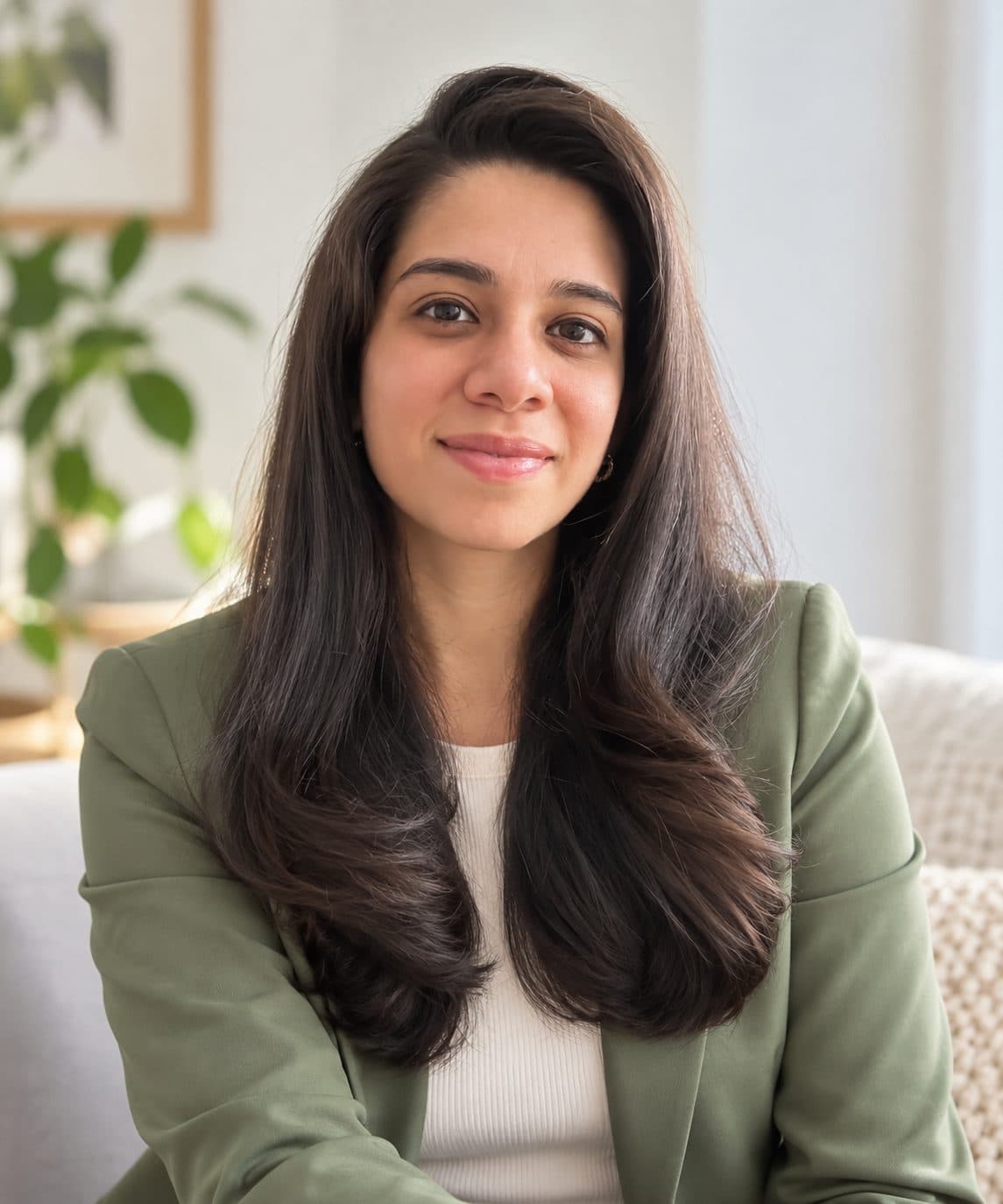

I’m a Registered Psychotherapist with the College of Registered Psychotherapists of Ontario (#17275), and I hold a Master’s in Counselling Psychology. I work online with adults living anywhere in Ontario.
My work brings your body into the conversation. Alongside talking, we pay attention to what your breath, muscles and attention are doing, drawing on my training in EMDR, Integral Somatic Psychology, CBT and mindfulness-based approaches.
I believe change often comes when your body, and not only your mind, gets to feel that what happened is over.
Not diagnoses. The things people actually say on the first call. You don’t need to recognise yourself in all of them.
Mostly trauma, and the anxiety, exhaustion and patterns that come with it. These three approaches, often together. You don’t need to know which you need before we talk.
For PTSD and complex trauma, from one event or from years of something. We build steadiness first, so the work stays manageable.
Read more about Trauma therapyFor memories that still hit as if they were happening now. A structured approach that helps your brain file them as past.
Read more about EMDR therapyFor when you understand what happened and your body still hasn’t caught up. We work with what your body is doing, gently.
Read more about Somatic therapyYou know your history. You can point to where your patterns began. And still, your body reacts as though the danger is happening all over again.
Understanding it and feeling better aren’t always the same thing.
Body-based trauma work goes past insight, to the part of you that learned to stay alert and protect you. It gives your nervous system the chance to experience something new: that what happened is no longer happening, and that you are safe now.
When you’re about to tell a stranger the hardest things in your life, the letters after their name are not a formality. Here is what the RP gets you, in plain terms.
In Ontario, only members of the College of Registered Psychotherapists of Ontario (CRPO) can call themselves a Registered Psychotherapist. “Therapist” and “counsellor”, on their own, are not protected: anyone can use them.
To register, a psychotherapist has to meet the College’s education and supervised-practice requirements and pass its entry-to-practice exam. My training is a Master’s in Counselling Psychology, followed by EMDR and Integral Somatic Psychology.
Registered Psychotherapists work to the College’s professional standards, take part in its quality assurance program, and handle your health information under Ontario’s health privacy law. If something went wrong, you would have somewhere to go.
Every Registered Psychotherapist is listed on the College’s public register, with their status and any conditions on their practice. Mine is below. It is worth checking anyone you are thinking of seeing.
My registration: Anjana Iyer, Registered Psychotherapist, CRPO #17275, authorized for independent practice. Check it on the College’s register.
The titles are confusing, and benefits booklets don’t help. All of these can be good people to see. What differs is what each is allowed to do, which college holds them to account, and how your plan treats them.
College of Registered Psychotherapists of Ontario
Psychotherapy: talking, body-based and structured therapies for trauma, anxiety, stress, relationships and more.
Cannot diagnose or prescribe. Covered by many extended health plans; check yours lists RPs.
Regulated by its own college in Ontario
Psychotherapy, plus psychological assessment and diagnosis, such as ADHD or learning assessments.
The one to see if you need a formal assessment or diagnosis. Some plans cover psychologists but not RPs, or the reverse.
Ontario College of Social Workers and Social Service Workers
Many provide psychotherapy; others work in hospitals, schools and community services.
Commonly listed on benefits plans. Training and focus vary widely, so ask.
A medical doctor, regulated by the College of Physicians and Surgeons
Diagnosis and medication. Some also offer psychotherapy.
Covered by OHIP, usually with a referral from your family doctor.
If you need a formal assessment or a diagnosis, see a psychologist. If you are wondering about medication, start with your family doctor. If what you want is therapy itself, help with something that keeps hurting, any regulated professional trained in that kind of work can be the right person, and how they work and how it feels to talk to them matters more than the title. Check which titles your plan covers, then choose on fit.
Most directory profiles say roughly the same things. These questions get past that. Ask them of anyone you’re considering. Here are my answers, so you don’t have to ask me.

Question 1
Yes. I’m a Registered Psychotherapist, CRPO #17275, authorized for independent practice. That last part matters: some people are listed as RP (Qualifying), which means they are still completing supervised hours. Here is my entry on the public register.
Question 2
A Master’s in Counselling Psychology, then EMDR (I’m an EMDR Canada Affiliate Member), Integral Somatic Psychology, CBT and mindfulness-based approaches. A good follow-up to ask anyone: how often do you actually use it? For me, EMDR and somatic work are most of what I do, not a line on a list.
Question 3
I work with adults, one to one. Most of my work is trauma, whether from one event or from years of something, along with the anxiety, burnout and patterns that tend to come with it. If what you’re bringing is outside what I do well, I’ll say so on the free call and suggest what kind of support to look for instead.
Question 4
We start with where you are now, not with the hardest part of your story. Early sessions are about understanding what’s going on and building enough steadiness that difficult things can be approached without overwhelming you. You set the pace, and you can pause or stop at any point.
Question 5
$180 for a one-hour appointment: 50 minutes together and 10 minutes for my notes. No HST is added. You pay at the session and I give you a receipt for your benefits; I don’t direct-bill, and OHIP doesn’t cover private psychotherapy. Fees and insurance in full.
Question 6
Then I’d rather we both know early. Fit with a therapist matters, and it’s fine to try someone and decide they aren’t right. That’s exactly what the free 15-minute call is for, and you can stop at any point after that too.

Fifty minutes, by secure video, from wherever you feel most like yourself.
We begin with where you are today. Early sessions are often about building enough steadiness and safety to approach difficult material without becoming overwhelmed. That foundation matters. It’s what allows the deeper work to happen at a pace your system can manage.
Not knowing what a call will be like is a good enough reason to keep putting it off. So here is the whole thing, in order.
By video or by phone, whichever feels easier. There's nothing to prepare, and no need to have your story figured out before we speak.
I'll ask what has been going on lately and what you've already tried. You can share as much or as little as feels comfortable. There's no need to tell your whole story or go into painful details on a first call. We can begin with what feels manageable.
I'll explain the approaches I use, how they may apply to what you're experiencing, and what you can expect from sessions with me. We'll talk about what the work might look like in practice, so you have a clearer sense of what beginning therapy would involve.
Registered psychotherapists are not permitted to publish client testimonials in Ontario, and I would not want to. These are endorsements from other registered therapists, left publicly on my Psychology Today profile.
Anjana brings something rare to her work: a trauma-informed, somatic approach grounded in EMDR and genuine attunement. She holds clients through the kind of healing that goes beyond the surface. A colleague I refer to with confidence.
Blanca Alagon
Registered Psychotherapist
Anjana is a thoughtful, compassionate, and highly skilled psychotherapist. She brings warmth, professionalism, and genuine care to her work, creating a supportive space where clients can feel understood and empowered to make meaningful change.
Max Tkachenko
Registered Psychotherapist, MEd, C-EFIT
Anjana is a compassionate therapist who supports adults with anxiety, trauma, relationship challenges, life transitions, and burnout. She brings a calm, steady presence and offers a culturally aware space where clients can reflect and move toward healing.
Kamakshi Marwah
Registered Psychotherapist, MA, MSc
A Registered Psychotherapist is a mental health professional registered with the College of Registered Psychotherapists of Ontario (CRPO). The title is protected in Ontario, so only College members can use it. Registered Psychotherapists provide psychotherapy, work to the College's standards, and are listed on its public register.
Not by OHIP, but many extended health plans cover Registered Psychotherapists. Plans differ, so check that yours lists RPs, what your annual maximum is, and whether you need a referral. I give you a receipt after each session to claim back.
Both can provide psychotherapy and both are regulated in Ontario. Psychologists can also carry out psychological assessments and communicate a diagnosis; Registered Psychotherapists cannot. If you need a formal assessment, see a psychologist. If you want therapy itself, either can be the right choice, and approach and fit matter more than the title.
No. You can book directly, without a referral from a doctor, and you don't need a diagnosis. Some insurance plans ask for a referral before they will reimburse, so check your plan first.
No. I work online only, by secure video, with adults anywhere in Ontario. You need to be physically in Ontario during sessions, in a private room where you can talk freely.
The calendar on this page shows the free-call times that are actually open. After the call, if we both think it fits, we book a first session at a time that suits you.
A free 15-minute call, by video or phone.
Bring your questions, including the ones on this page. You’ll hear how I work and get a sense of whether talking with me feels right, with nothing to decide on the call.
Want the practical details first? Read about fees and insurance or how online sessions work.